
HERLEV BYGADE
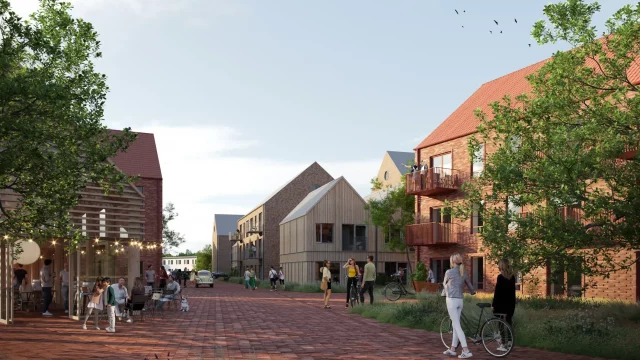
The masterplan is organized around a primary urban spine – a car-free promenade that creates a vital shortcut for the neighborhood. This “public vein” ensures that the site remains an integrated part of the city rather than a secluded island. By breaking down the traditional block structure, the project introduces a varied typology of townhouses and low-rise apartments. This architectural rhythm ensures optimal daylight conditions and a human-centric scale that resonates with the nearby historic context. The design language honors the local craft heritage of the Saxbo stoneware factory that used to be on the site.
The landscape concept, developed as an integrated social ecosystem, transitions from the active urbanity of the street to the intimacy of the courtyard. Four distinct green “rooms” are carved out between the buildings, each offering unique atmospheres for recreation, play, and quiet contemplation. These courtyards act as shared living rooms, fostering a sense of community across generations.
Sustainability is not just a technical layer but a visible landscape feature. Local rainwater management (LAR) is integrated into the lush greenery, turning climate adaptation into an aesthetic and educational asset.
- Location Herlev, Denmark
- Client AG gruppen, Urban Partners (Nrep)
- Year 2025-28 (detailed design and construction)
- Status Construction phase
- Program Housing areal, apartments
- Site area 15.400 m2
- Floor area 16.300 m2
- Collaborators P+P arkitekter, Ekolab, Henry Jensen rådgivende ingeniører
- Team Sara Buhl Bjelke, Rune Veile, Arne Cermak Nielsen, Alessia Col, Alida Buch Hansen, Grace Sheehan, Luna Liv Greve, Mustafa Cakir, William Yen
HERLEV BYGADE HERLEV DK
slide for projects
view project